Author Archives: Mia Moffett

Wurts Bros. New York City Photography

X2010_7_1_12414

Wurts Bros. (New York, N.Y.) Rockefeller Center. Ca. 1931. Museum of the City of new York. X2010.7.1.12414

Many photographers have captured New York City architecture over the years, but few have been so prolific, nor have they documented the construction of so many iconic New York City landmarks as the Wurts Brothers.

In 1894 Lionel and Norman Wurts established one of the first architectural photography studios in New York City.  Over the next 85 years the two brothers, and later Lionel’s son, Richard, gained recognition and many prominent clients including Cass Gilbert (The Woolworth Building), Consolidated Gas Company (now known as Con Ed) , and Skidmore, Owings & Merrill (the firm now building One World Trade Center).

X2010_7_1_2507_117477 001

Wurts Bros. (New York, N.Y.) Wurts Brothers Signs. Ca. 1919. Museum of the City of New York. X2010.7.1.2507

The Wurts Bros. worked alongside architects, engineers, and rental agents to record major New York City landmarks under construction during some of the city’s most dynamic years of expansion. Their images are widely recognizable and have been reproduced in many architectural and general interest magazines over the years. The Museum of the City of New York retains the firm’s archives of over 45,000 prints and negatives. Over the last four years our Collections team has worked on cataloging, rehousing, and digitizing this collection, supported by two generous grants from the Leon Levy Foundation.

A good example of the historic record contained within the Wurts Bros. photographs is the construction of the Woolworth Building.  On April 24, 1913, nearly 100 years ago, construction was completed on the 792-foot skyscraper. The Woolworth Building was the tallest building in the world until 1930, when the Chrysler Building would overtake it.

woolworths

Clockwise from upper left hand corner: Wurts Bros. Woolworth Building, exterior from S.E Corner. February 3, 1912. Museum of the City of New York. X2010.7.1.3857. Wurts Bros. Woolworth Building, exterior from S.E. April 4, 1912. Museum of the City of New York. X2010.7.1.3875. Wurts Bros. Broadway and Barclay Street. Woolworth Building, general view from S.E. April 8, 1913. Museum of the City of New York. X2010.7.1.4390. Wurts Bros. Woolworth Building, general exterior from S.E. June 7, 1912. Museum of the City of New York. X2010.7.1.3886

The Wurts Bros. captured the majority of their beautiful images utilizing a large format view camera and glass plate negatives, which render the images incredibly sharp, striking, and detailed.  They shot with wide angle lenses and bellows that allowed them to twist and turn the camera for spectacular views that are otherwise impossible to see. To a viewer standing at ground level looking up, buildings appear tall and skinny like a needle. To correct for this misleading perspective, Lionel Wurts crafted a technique of shooting from the upper floors of an adjacent building while skillfully working with the camera bellows and lenses to create perfectly even and square portraits of skyscrapers and buildings. The majority of the Wurts Bros. collection was captured on these large, heavily detailed glass plate negatives, but as acetate film became more ubiquitous they began to shoot with smaller format film as well.

Wurts Bros. (New York, N.Y.) Broadway and Exchange Place. Norman Wurts making photos from 4th-story ledge on Exchange Court Building, 1937. Museum of the City of New York. X2010.7.1.8427

Wurts Bros. Broadway and Exchange Place. Norman Wurts making photos from 4th-story ledge on Exchange Court Building, 1937. Museum of the City of New York. X2010.7.1.8427

Here are some fabulous examples of the type of documentary style the Wurts Bros. are best known for:

X2010_7_1_730

Wurts Bros. (New York, N.Y.) 5th Avenue West 58th Street. Central Park South. Plaza Hotel. Ca. 1905 Museum of the City of New York. X2010.7.1.730

X2010_7_1_1948

Wurts Bros. (New York, N.Y.) Broadway and 34th Street. R.H. Macy Co. Ca. 1915. Museum of the City of New York. X2010.7.1.1948

The Wurts Bros. were also contracted to photograph facades and interiors of luxurious New York residences like this one from 40 West 57th Street, giving  viewers a glimpse inside spectacular upper class residences they could only before imagine.

Wurts Bros. 40 West 57th Street. H.B. Gilbert residence, front. Ca. 1910. Museum of the City of New York. X2010.7.1.11

Wurts Bros. (New York, N.Y.) 40 West 57th Street. H.B. Gilbert residence, front. Ca. 1910. Museum of the City of New York. X2010.7.1.1185

Wurts Bros. (New York, N.Y.) 40 West 57th Street. H.B. Gilbert residence, parlor at windows. Ca. 1910. Museum of the City of new York. X2010.7.1.1196

Wurts Bros. (New York, N.Y.) 40 West 57th Street. H.B. Gilbert residence, parlor at windows. Ca. 1910. Museum of the City of new York. X2010.7.1.1196

The Wurts Bros. name is also synonymous with the New York World’s Fair Exhibition of 1939. Richard Wurts, the son of Lionel, documented the construction and grandeur of the fair grounds. In the winter of 1939 he had a one man show of these photos at the Museum of the City of New York called “Building the 1939 New York World’s Fair.” Here are some photos from the exhibition:

39_567_1_031-copy

Richard Wurts. Supreme (Food and Sports Building, dome). 1938. Museum of the City of New York. 39.567.1.31

39_567_1_011-copy

Richard Wurts. See My Shadow (Perisphere from top Trylon). 1938. Museum of the City of New York. 39.567.1.11

X2010_7_1 030

Wurts Bros. (New York, N.Y.) ca. 1939. View of World’s Fair from a subdivision. Museum of the City of New York. X2010.7.1.15559

X2010_7_1 1398

Wurts Bros. (New York, N.Y.) ca. 1939. Richard Wurts with his photograph of World’s Fair. Museum of the City of New York. X2010.7.1.15437

Operating as a commercial studio through several generations of New York City history, the Wurts Bros. had a broad spectrum of clientele. They chronicled everything from skyscrapers to houses; office buildings to schools; tools to artwork. They documented so much of New York City that it’s hard to find something they didn’t photograph.

X2010.7.1.304

Wurts Bros. (New York, N.Y.) Madison Avenue at the corner of 129th Street. All Saints Roman Catholic Church, interior view looking at organ. Ca. 1905. Museum of the City of New York. X2010.7.1.304.

wurts_G0810_808019 001

Wurts Bros. (New York, N.Y.) 31st Street and 6th Avenue, N.W. corner. Greeley Square Building, men’s urinal partitions. Museum of the City of New York. X2010.7.1.6250

X2010_7_2_07577

Wurts Bros. (New York, N.Y.) Master plumber with lead windmill model made up of lead wiped joints, lead pipe, 1931. Museum of the City of New York. X2010.7.2.7577

Wurts Bros. (New York, NY) Museum of the City of New York. X2010.7.1.5505

Wurts Bros. (New York, NY) 40th Street and 5th Avenue. Murphy Door Bed Co., interior, Ca. 1921. Museum of the City of New York, X2010.7.1.5505

For more images click here

Photographing Our Painting Collection

Here in the Museum of the City of New York’s Collections Department we have embarked on an exciting new project to digitize selected objects from our paintings holdings. This is the first time we have shot paintings and, while every object in our collection requires special attention while being photographed, when we start a new medium there are always new things to consider. In this case we had to think about how to deal with shiny surfaces that reflect light and create highlights that are hard to remove by merely adjusting the angle of our lights. We purchased custom filters for our Broncolor Lightbars fit with a polarized film and then attached a polarizing filter to the lens of our Hasselblad H4D. If you have ever worn polarized sunglasses then you know that looking through a polarizing filter greatly reduces glare and reflections from shiny surfaces. With the added polarizing film on our lights and the polarizing filter on our camera lens we are able to completely zero out all reflections coming off the painting and spilling into our camera. If you would like a complete breakdown of how polarization works read this.

Here is an example of New York politician and judge Gabriel George Ludlow, shot with and without the polarizing filter so you can see how really effective this method is. The artist of this beautiful portrait, John Singleton Copley (1738-1815), was an influential painter in colonial America and is well-known for his portraits of prominent figures.

John Singleton Copley (1738-1815). Gabriel George Ludlow. ca. 1770. Museum of the City of New York. 72.31.

John Singleton Copley (1738-1815). Gabriel George Ludlow. ca. 1770. Museum of the City of New York. 72.31.

We are very excited to make these paintings accessible to researchers and curators to view and study without having to make a trip to our storage facility. The portrait collection consists of prominent New Yorkers by many well-known artists from the early 1700′s through the 1980′s. Some of the real gems of our collection include portraits of DeLancey Iselin Kane and Eleanora Iselin Kane by the artist Thomas Wilmer Dewing (1851-1938). The portrait of DeLancey Iselin Kane is considered his most famous portrait and has been published extensively. The painting is in its original frame, designed specifically for the portrait by Stanford White.

Thomas Wilmer Dewing (1851-1938). DeLancey Iselin Kane. 1887. Museum of the City of New York. 40.417

Other paintings of note are the James Abercrombie Burden Family by Eastman Johnson; Cornelius and Sarah Bogart Ray by John Wollaston; and A Spanish Boy by Alice Neel.  Many of these paintings underwent restoration and cleaning prior to their digitization. Our painting collection ranges from the typical turn-of-the-century portraits as seen above to this dark and moody portrait of John Barrymore in the character of Hamlet painted by James Montgomery Flagg (1877-1960) ca. 1923.

James Montgomery Flagg (1877-1960). John Barrymore as Hamlet. ca. 1923. Museum of the City of New York. 46.414.1.

We set up a temporary studio for three days in a temporarily empty gallery on our newly renovated third floor.  Here is a shot of our setup in action. Please check in with our collections portal in the near future to view this amazing collection in your own home.

Construction of the 74th Street Power Station

For the past two weeks I’ve had the pleasure of digitizing our photographs of the construction of the 74th Street Power Station located on the East River between 74th and 75th Streets. Most power plants in New York City at the turn of the 20th century were located on either the Hudson or the East River because they used the river water as a coolant.

Photographer unknown. 74th St. Power Station Looking North. June 17, 1902. Museum of the City of New York Photography Collection. F2012.53.308A

This power station, designed by George H. Pegram, is still in use today and I was blown away by its beauty.  The Manhattan Elevated Railway Company broke ground in 1899 on the 200 x 500 foot power house and it was fully operational by 1902. It began its life as a coal-powered plant designed to supply electricity to the elevated trains of New York City, which were in the process of being converted from coal to electricity. The city at the time was badly in need of relief from the soot and pollution from the coal-powered steam engines. By 1904 “the power for the operation of all trains on the Manhattan Railway Division [was] generated at one power station located near the centre of the system on the East River, between 74th and 75th Streets.”  The New York Electrical Handbook, by the American Institute of Electrical Engineers

Photographer unknown. Trench Looking East. May 31st 1900. Museum of the City of New York Photography Collection. F2012.53.170E

Photographer Unknown. 74th St. Power Station Looking East. October 11th 1900. Museum of the City of New York Photography Collection. F2012.53.211A

The main towers were the first part of the building to be completed, in October, 1900.

Photographer unknown. 74 St. Power Station from East River. Museum of the City of New York Photography Collection. F2012.53.228A

You can see here that from February to June 1901 the engine room was almost fully completed.

Photographer unknown. 74th St Power Station Looking East. February 21, 1901. Museum of the City of New York Photography Collection. F2012.53.243A

Photographer unknown. 74th St Power Station Looking East. June 20, 1901. Museum of the City of New York Photography Collection. F2012.53.267B

According to the IEEE Global History website regarding the history of railway power stations of New York City: “Originally, the power house was equipped with eight huge Allis-Corliss reciprocating steam engines, each rated at 10,000 horsepower maximum. Each engine drove directly a Westinghouse three-phase, 11,000 volt, 25-cycle alternator rated for 7500 kilowatts.” At the time these eight Westinghouse alternators were the largest ever built!

Photographer unknown. 74th St Power Station Looking West. February 20.1902. Museum of the City of New York Photography Collection. F2012.53.315B

Here is the completed engine room with those impressive steam engines cranking away.

Photographer unknown. 74th St Power Station Engine Room at Night. Museum of the City of New York Photography Collection. F2012.53.321C

I especially loved the photographs of the men who built this amazing example of engineering and construction.

Photographer unknown. 74th St Power Station Looking West. August 1, 1901. Museum of the City of New York Photography Collection. F2012.53.275D

Photographer unknown. 74th St Power Station Looking West. March 20, 1902. Museum of the City of New York Photography Collection. F2012.53.297A

Photographer unknown. 74th St Power Station Looking North. February 6, 1902. Museum of the City of New York Photography Collection. F2012.53.286C

Photographer unknown. 74th St Power Station Looking West. August 22, 1901. Museum of the City of New York Photography Collection. F2012.53.279B

Though the 74th Street Power Station is still in use today, it is no longer coal powered. In 1959 the plant was taken over by the Consolidated Edison Company and it continued to supply coal power to substations in Brooklyn, Manhattan, and Queens. In 1999 new boilers and gas turbine generators replaced steam ones and the station continues to contribute to the city’s electric power grid.  For more information about this and all power stations in New York, you can read the IEEE Global History Network’s page on the Railway Power Stations of New York City.

Riding the Subway with Stanley Kubrick

As most New Yorkers know, the subway system is the lifeline of New York City.   In 1946 Stanley Kubrick set out as a staff photographer for LOOK Magazine to capture the story of New York City’s subway commuters.

Kubrick was not the first photographer to depict the New York City subway.  In 1938 Walker Evans shot many amazing portraits of unknowing riders with a camera hidden in his coat. This may have influenced Kubrick’s work. This Kubrick  image is a very “shot from the hip,” Walker Evans-style portrait.

Stanley Kubrick. Life and Love on the New York City Subway. Passengers in a subway car. 1946. Museum of the City of New York. X2011.4.10292.26C

As you can see below, with the exception of iPods and smart phones, activities on the train haven’t changed much in the last 66 years, including shoving one’s newspaper in everyone else’s faces.

Stanley Kubrick. Life and Love on the New York City Subway. Passengers reading in a subway car. 1946. Museum of the City of New York. X2011.4.10292.30D

Stanley Kubrick. Life and Love on the New York City Subway. Passengers in a subway car. 1946. Museum of the City of New York. X2011.4.10292.55E

Stanley Kubrick. Life and Love on the New York City Subway. Passengers in a subway car. 1946. Museum of the City of New York. X2011.4.10292.52B

Stanley Kubrick. Life and Love on the New York City Subway. Woman knitting on a subway. 1946. Museum of the City of New York. X2011.4.11107.16

Stanley Kubrick. Life and Love on the New York City Subway. People on escalators in a subway station. 1946. Museum of the City of New York. X2011.4.10292.61C

Stanley Kubrick. Life and Love on the New York City Subway. Woman waiting on a subway platform. 1946. Museum of the City of New York. X2011.4.10292.81B

Stanley Kubrick. Life and Love on the New York City Subway. Women in a subway car. 1946. Museum of the City of New York. X2011.4.10292.11E

Stanley Kubrick. Life and Love on the New York City Subway. Men sleeping in a subway car. 1946. Museum of the City of New York. X2011.4.10292.73C

Although it is now claimed that chivalry is dead, it was definitely waning in 1946.

Stanley Kubrick. Life and Love on the New York City Subway. Passengers in a subway car. 1946. Museum of the City of New York. X2011.4.10292.56E

BUT romance still thrived on some trains.

Stanley Kubrick. Life and Love on the New York City Subway. Couple playing footsies on a subway. 1946. Museum of the City of New York. X2011.4.10292.90E

Stanley Kubrick. Life and Love on the New York City Subway. Man carrying flowers on a crowded subway. 1946. Museum of the City of New York. X2011.4.10292.37C

Here is an explanation from Kubrick about how he took these photographs:

“I wanted to retain the mood of the subway, so I used natural light,” he said. People who ride the subway late at night are less inhibited than those who ride by day. Couples make love openly, drunks sleep on the floor and other unusual activities take place late at night. To make pictures in the off-guard manner he wanted to, Kubrick rode the subway for two weeks. Half of his riding was done between midnight and six a.m. Regardless of what he saw he couldn’t shoot until the car stopped in a station because of the motion and vibration of the moving train. Often, just as he was ready to shoot, someone walked in front of the camera, or his subject left the train.

Kubrick finally did get his pictures, and no one but a subway guard seemed to mind. The guard demanded to know what was going on. Kubrick told him.

“Have you got permission?” the guard asked.

“I’m from LOOK,” Kubrick answered.

“Yeah, sonny,” was the guard’s reply, “and I’m the society editor of the Daily Worker.”

For this series Kubrick used a Contax and took the pictures at 1/8 second. The lack of light tripled the time necessary for development.

— “Camera Quiz Kid: Stan Kubrick,” The Camera, October 1948

Photographing the Postcard Collection

Allyson photographing postcards.

Ever wonder how much work goes into digitizing a collection for view on our Collections Portal?  Here at MCNY, the digital team has been hard at work numbering, shooting, and cataloging our collection of 7,691 New York City postcards.   It took about 20 days of photography shooting 400 to 600 postcards each day.  After imaging, the files are sent to our catalogers who research information such as location, date, and publisher. The keywords they apply allow the images to be searchable in our database and online.

Our postcard collection ranges from the 1890s through the 1990s, with particular strength in the early 1900s, when a postcard craze swept the nation, as explained by the Metropolitan Postcard Club of New York City:

An accumulation of factors led to an explosion in the popularity of postcards during these years. The American middle class had grown much larger in size, and the excess money it had to spend on nonessential goods was enough to support a large industry [...] Photography and printing technology had also advanced to a point that enabled high quality images to be produced in tremendous numbers and they were. Card dealers began to outnumber booksellers. Over 7 billion postcards were mailed worldwide in 1905, almost one billion in the United States alone; and this does not account for those that ended up in collections rather than the mailbox.

The images include popular tourist subjects such as aerial views of  lower Manhattan and major landmarks, but also incorporate some eccentric imagery and views outside of Manhattan,  like the three examples below.

Greetings from the Bronx, ca. 1910. Museum of the City of New York. X2011.34.1795.

Central Park Menagerie. Feeding a Snake, New York, 1905-1914. Museum of the City of New York. X2011.34.1588.

Kings County Jail, Raymond Street, ca. 1915. Museum of the City of New York. X2011.34.1823.

While most of these were purchased as traveler’s cards to be sent to family and friends back home, quite a few were actually sent within New York City  limits.  In an age before you could just send a quick text or email, postcards were a fast and informal way to get in touch with someone who did not yet own a telephone.

Capturing some of the postcards in a digital format proved challenging.  Most were the standard 3 1/2″ by 5″ but some were specialty fold out postcards. Here is an example of a particularly complicated one.  This was a folded paper postcard from the 1939 World’s Fair. When expanded and viewed through a hole in the front of the card, the viewer sees a three dimensional landscape.  Our photographers found that the best way to capture the view was to tie the postcard underneath the lens and allow it hang open while being photographed.

View captured through the lens. New York World's Fair, 1939. Museum of the City of New York. F2011.33.2119.

Front cover of the postcard - by looking through the cutout one can view the telescoping image.

Several other postcards include special fold-out sections that provide a view of the New York City skyline.

Irving Underhill (d. 1960). New York Skyline, 1900. Museum of the City of New York. X2011.34.3006.

As an added enticement to the consumer, postcard companies often hand applied tinseling or glitter to the views to enliven the image – often incongruously, as in this bedazzled depiction of Grant’s Tomb.

General U. S Grant Monument & Tomb, New York, ca. 1910. Museum of the City of New York. F2011.33.14.

Not every postcard showed exciting and interesting places such as Coney Island and the Empire State Building; here is a postcard showing the Metropolitan Life Insurance Co.’s new women’s lunch room:

Lunch room, Metropolitan Life Insurance Company, ca. 1910. Museum of the City of New York. X2011.34.325.

One of our favorite postcards is this multiple choice “busy person’s correspondence card” showing the Empire State Building.

Empire State Building at Night, New York City, 1934-1940. Museum of the City of New York. X2011.34.3492.

We are in the process of uploading the postcard collection to the Portal. Look for it online in the next week or two.

The Digital Team Gets New Digs!

The Museum of the City of New York’s digital team is proud to announce that we have moved into our new digital lab!  For almost two years we have been working out of temporary space in the Museum’s research room.

Our previous digital studio

The new lab was  designed by Michael Ulsaker of Ulsaker Studio, Inc., and is fitted with state-of-the-art camera equipment.  Mr. Ulsaker specializes in “designing high-end digital imaging solutions for commercial studios and museums.” In addition to us, he’s worked with the Widener Library and Sackler Museum at Harvard, the Boston Museum of Fine Arts, the Virginia Museum of Fine Art, and many other museum and commercial clients.

Our new equipment includes a larger copystand custom built by Mr. Ulsaker to fit our needs.  It is equipped with a foot-pedal controlled vacuum frame that can accommodate 2-dimensional works up to 46″ by 46″ and which allows us to gently flatten artwork and photographs while photographing them.  The new table is motorized and is adjustable from 9.5″ above the ground to 46″ high.  It also has wheels so it can be moved out of the way completely to photograph large 3-dimensional objects or to slide back and forth so large objects can be shot in parts and then stitched together in Photoshop.

Michael Ulsaker installing the new camera arm

Our camera is the Hasselblad H4D-50ms which is now mounted directly to the wall on a motorized arm that can easily be moved up and down with a hand held joystick.  It can also move in and out from the wall which  saves space and time when framing up a shot.

Michael Ulsaker and Harlan Erskine installing the Lightbars

The lab also comes with new high-end Broncolor Lightbar 120 strobe lights which are mounted to the ceiling on scissor arms attached to a Manfrotto track system.  Each pack has its own Broncolor Scoro power pack which is also mounted onto the rigging system.  The lights slide easily along the track and can be moved up and down smoothly to light objects of nearly any size or shape.  Having the lights mounted to the ceiling rather than on floor stands provides  a more stable and safer environment for sometimes  fragile collections objects.

Mr. Ulsaker’s ingenuity has aided us through every step of this process.  Below is an apparatus he designed and built just for us so we can quickly photograph negatives with the Hassleblad camera instead of scanning them.  This really helps us speed up production on large collections of negatives and allows us to easily position the negatives below the camera and also raise them off the hot lightbox which could damage the negatives and cause them to warp.

We are extremely excited about our new space and are even more excited about all the new types of objects we are now able to digitize and make available to the public. Visit our Collections Portal to view more than 60,000 photographs of historic New York City. Look for 35,000 new images later this fall from the Museum’s prints, drawings, and maps collections.

Our new studio in action

Marching Ghosts

This striking photograph by Lois Hobart of several ghostly legs and blurred bodies was shot during the New York City Columbus Day Parade of 1945. The camera was set up on a tripod and the image was shot with a very slow shutter speed to blur the marchers as they sped past the photographer down Fifth Avenue.  All that can be seen of them is the one leg positioned on the ground as their other leg and entire bodies are blurred while they swing forward.  This photograph is fascinating because usually people try not to create blurry photographs.  The goal of most photographers is a crisp, in focus photograph.  By blurring the marcher’s movement, Hobart captured the energy and motion of the parade, even though the picture’s subjects are almost completely removed!

This photograph illustrates what Henri Cartier-Bresson referred to as the “decisive moment”: an image in which several elements come together for a fraction of a second while the photographer is pressing the shutter and freezing the moment onto film for eternity.  It’s a moment that can never be replicated and almost seems to be purely chance, but is really the product of great skill on the photographer’s part.  If Hobart had released the shutter a fraction of second sooner or later, either much more or much less of the marchers’ bodies would appear.  They could even be completely removed from the photograph all together.  And, if the marchers were moving even a little faster or slower or if the shutter speed was faster or slower, the photograph would be completely different.  This is the “decisive moment” that  engages you and remains in your memory.

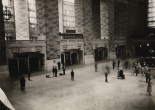
Shot in the middle of Grand Central Station in 1928, this shot also explores the use of long shutter speeds to show the passage of time.   It shows many travelers moving through the station on the way to their trains, most of whom become just small blurs in the foreground.  The only people who are truly visible were standing either completely or mostly still for the duration of the shot.  Any person walking or running through the station to catch a train is only recorded as a haze of legs and feet.  The blurred movement gives the feel and energy of Grand Central Station in transit.